

Minivans are having a weirdly good moment again. Not in a nostalgic, “remember the family road trip” kind of way only. In a practical way. People still want sliding doors, real third-row access, useful cargo room, and something that does not feel like a giant compromise every time they drive it. Now add electrification to that mix, and suddenly the category gets a lot more interesting.
That is what makes 2026 such a useful checkpoint. The segment is still small, yes, but it is no longer empty. Volkswagen already has the ID. Buzz in the market, Kia has pushed into the space with the PV5 Passenger, Mercedes still offers the EQV in Europe, Volvo has the EM90 in China, and Mercedes has already positioned the VLE as the next big electric luxury people mover, with production starting in 2026 and U.S. arrival slated for 2027. So no, this is not some vague future promise anymore. It is turning into a real category.
The phrase electric minivan 2026 finally means more than one obvious answer. A year or two ago, most shoppers could only really point at the Volkswagen ID. Buzz and call it a day. In 2026, the field is broader, even if availability still depends heavily on where someone lives. The U.S. gets the strongest minivan-style presence from the ID. Buzz right now, while Europe and parts of Asia have more MPV-like EV choices already on sale or in rollout.
That matters because minivan buyers usually are not chasing hype. They want useful packaging. Easy entry. Flexible seating. Real family or shuttle practicality. The reason the category feels promising in 2026 is not just that it is electric. It is that manufacturers are finally treating van-shaped EVs as desirable products rather than awkward fleet tools. That shift is easy to see in today’s Best Electric Vans and Minivans for 2026 conversation, where comfort, cargo space, and tech now matter as much as battery size.
SUVs still dominate, obviously. But they do not solve every problem. Families with kids, airport transfer operators, hotel fleets, and buyers who care about step-in height still benefit from a proper van layout. Sliding doors are still brilliant. Low floors still matter. Third-row access still matters. Funny how those things never stopped being useful.
That is also why the newest electric minivan models are getting more attention. Buyers are starting to realize that an EV van can offer the quiet ride and smooth acceleration people like in electric cars, while also preserving the everyday usefulness that made minivans valuable in the first place. And if the packaging is done well, they can feel far roomier than a three-row SUV.
A quick look at current New Electric Minivan/MPV models shows the range of approaches:
That variety is a big deal. It means the segment is no longer trying to be one thing.
If someone says electric minivan 2026, the ID. Buzz is still the headline model for a lot of buyers, especially in the U.S. Volkswagen’s U.S.-market ID. Buzz offers available all-wheel drive, industry-leading third-row legroom according to VW, more than 160 cubic feet of passenger space, and up to 145.5 cubic feet of cargo room with the second row folded and the third row removed. VW also says it can charge from 10 to 80 percent in 26 minutes on a 200 kW DC fast charger.
Why it stands out is not just the look, though the look definitely helps. It is that Volkswagen made it feel like a real family-first EV instead of a van people are expected to apologize for liking. It is roomy, cheerful, and honest about its purpose. Not every buyer will love the price, sure, but the packaging is hard to ignore. That is one reason it keeps showing up in nearly every Best Electric Vans and Minivans for 2026 discussion.
Read More: AWD Minivans That Make Family Travel Safer in 2026 Weathers
The Kia PV5 Passenger may end up being one of the most important additions to the category, even if its market rollout is uneven. Kia says the PV5 Passenger uses a 71.2 kWh battery, 120 kW of peak motor output, up to 412 km WLTP range, and 10 to 80 percent charging in 30 minutes. It also packs in 1,330 liters of luggage space behind the cabin and leans heavily into practical storage and passenger usability.
What makes it interesting is the tone of the thing. It feels less nostalgic than the VW and more purpose-built. More squared off. More modular. More like it knows it may carry kids one day, equipment the next, and work bags after that. For buyers who care more about layout than image, this is exactly why electric minivan models are becoming more compelling. Some of them are finally designed around use first.
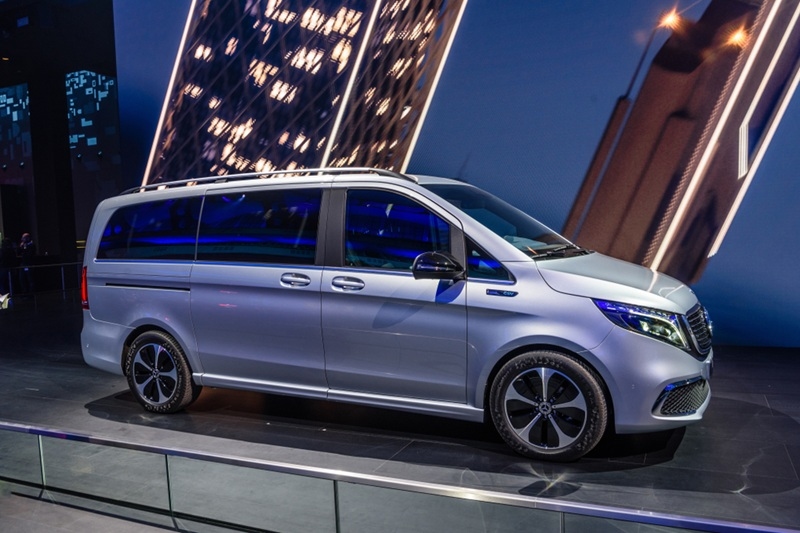
The electric van story is not only about family hauling. There is also a growing luxury MPV lane, and Mercedes plus Volvo are taking that seriously. Mercedes’ EQV remains a live example of that approach. Mercedes lists the EQV 300 Executive Long with 222 miles of WLTP range, 93.3 kWh usable battery capacity, seating for seven, and a 4,630-liter boot figure in its UK specs.
Volvo’s EM90 goes even further into lounge-like premium territory. Volvo describes it as a fully electric premium MPV and says it launched first in China, where the brand sees strong demand for the segment. That alone tells buyers something important: the market for upscale electric people movers is real enough for major brands to keep investing in it.
These are not bargain family vans, obviously. But they show where the upper end of New Electric Minivan/MPV models is heading. Quiet cabins. business-class seating ideas. More “mobile room” than “practical hauler.” That may sound niche, and maybe it is, but niches often shape the direction of a segment.
Then there is the VLE, which feels like the bridge between electric van practicality and high-end digital luxury. Mercedes says the VLE will be an electric grand limousine with seating for up to eight, and the U.S. brand page says it will arrive on American roads in 2027. Separately, Mercedes-Benz Group says the VLE starts the new van architecture era in 2026.
So no, it is not a 2026 U.S. sale story yet. But it absolutely belongs in the 2026 conversation because it shows where the category is going. More flexible seating. More premium tech. More confidence from brands that used to treat vans as background products. This is the kind of shift that changes how people talk about electric minivan 2026 as a category, not just a single model year search term.
Specs are useful, but minivan buyers usually shop with a different brain. They care about day-to-day friction. How easy is it to load a stroller? Can adults actually use the third row? Is the charging speed good enough for road trips? Does the cabin feel airy or claustrophobic?
A smart shortlist should probably focus on:
A van should feel easy to enter and easy to move around in. That sounds basic. It is still where many three-row vehicles disappoint.
The ID. Buzz’s fast charging and the PV5’s 30-minute 10 to 80 percent figure are the kinds of numbers buyers should care about more than headline battery bragging.
This part is annoying but important. Some of the most appealing electric minivan models are not sold everywhere, and some are clearly market-specific for now. Volvo’s EM90 is China-first. Mercedes’ EQV is Europe-focused. The VLE reaches the U.S. later.
Family buyer? Shuttle operator? Premium chauffeur service? The best van changes depending on the answer.
Check Out: Family Minivan Rental Tips for a Comfortable Family Travel
Yes, actually. Maybe not because the segment is already huge, because it is not. But because it has finally become credible. There is now enough variety to see the shape of the future. One model leans playful. One leans modular. One leans executive. One leans ultra-premium. Another points to the next phase already.
That is why the Best Electric Vans and Minivans for 2026 question is more interesting than it first sounds. It is not just about picking one van. It is about seeing a category wake up.
Sometimes, yes. A true minivan shape usually gives buyers easier third-row access, better sliding-door practicality in tight parking spaces, and a lower step-in height for kids or older passengers. Three-row SUVs can look tougher and feel more mainstream, but they often lose some of that day-to-day usability. For families who care more about function than image, the van layout still has a real advantage.
Because regional demand is different. Europe and Asia have stronger traditions around vans, MPVs, and people movers as everyday vehicles, executive shuttles, or premium family transport. In the U.S., automakers have spent years pushing large SUVs instead, so the van comeback is slower. That does seem to be changing, though, especially now that EV packaging makes roomy interiors easier to justify.
That depends on what they need right now. Buyers who want a fully electric van today already have real options in some markets, and the ID. Buzz gives U.S. shoppers an actual product instead of a concept promise. But anyone who is not in a rush may benefit from waiting, because the next wave, especially vehicles like the VLE, should bring more range, more tech, and more variety to the segment.
This content was created by AI